
October 2026
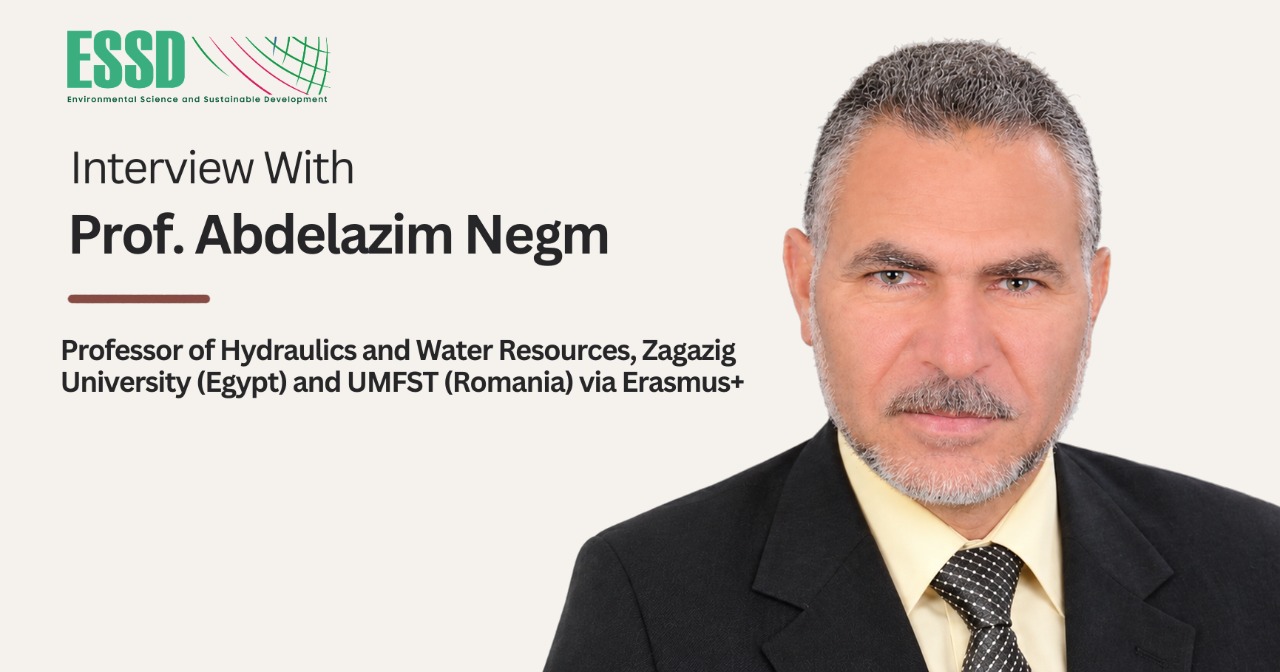
Prof. Abdelazim Negm is a Professor of Hydraulics and Water Resources at Zagazig University (Egypt) and UMFST (Romania) via Erasmus+. Prof. Abdelazim has served as a member of the journal’s Editorial Board and has been contributing to the journal since its establishment. His experience, dedication, and continued contributions make him a valuable asset to the journal.
ESSD Editorial Team spoke with Prof. Negm about emerging research topics, peer review, common weaknesses in submitted papers, and how researchers should choose a journal.
1. Could you briefly introduce your academic background and current research interests?
My academic background is in irrigation and environment, hydrology, and hydraulics. Currently, I am very interested in environmental engineering and related sustainability studies, including Earth's water cycles.
2. Which research topics do you think will attract more attention in the coming years?
AI, machine learning, and how they can improve future modeling, sustainability, and management of environmental challenges.
3. How can peer review be improved, and how can reviewers receive better recognition?
Ethical peer review is one of the main cornerstones of the publication process. Without ethical and rigorous peer review, the knowledge landscape could be polluted, leading to retractions of some publications. Publishers should carefully consider how to share some of the benefits with reviewers to encourage them to continue their critical role in protecting knowledge from pollution and/or corruption.
4. What common problems do you find in papers in your field, and how can authors avoid them?
Authors sometimes provide a weak state-of-the-art or start locally, when they should start globally, then regionally, and end with local studies. Sometimes the objectives are unclear and/or the research gap is not well identified. The methodology cannot be repeated. Sometimes, conclusions are not solid, and many papers miss recommendations.
I suggest that each author follow a scientific article writing checklist:
- A well-structured abstract, followed by five keywords that appear in the abstract and are frequently repeated in the paper.
- A concrete introduction that starts with the global importance of the topic, then a relevant state of the art, and ends with the research gap followed by the objectives.
- Materials and Methods, starting with a detailed flowchart of the methodology, followed by the selection of case data and data collection, then a detailed explanation of the methodology so it can be replicated.
- Results, discussion, conclusions, and recommendations.
- Acknowledgment, followed by the AI declaration, conflict of interest statement, author contributions, etc., and the references cited in the paper.
Each of the four components has different elements that should be included in the checklist. Each journal should prepare such a checklist based on its scope and style and post it on the journal/publisher website.
5. What factors should researchers consider when choosing a journal for their work?
Publisher reputation, journal quality and ranking that best fits the paper, themes and topic coverage of the journal, and publication lifecycle to understand the publication processes and judge whether there is a gap or not to be satisfied with the publication processes, etc.
We sincerely appreciate the time and expertise Prof. Negm shared with us.
ESSD Editorial Team